

Home / Trends / Newsroom / Article
Original Reuters Plus Feature: Taiwan Brings Excellence to a New Generation of Intelligent Mobility — Reuters Plus
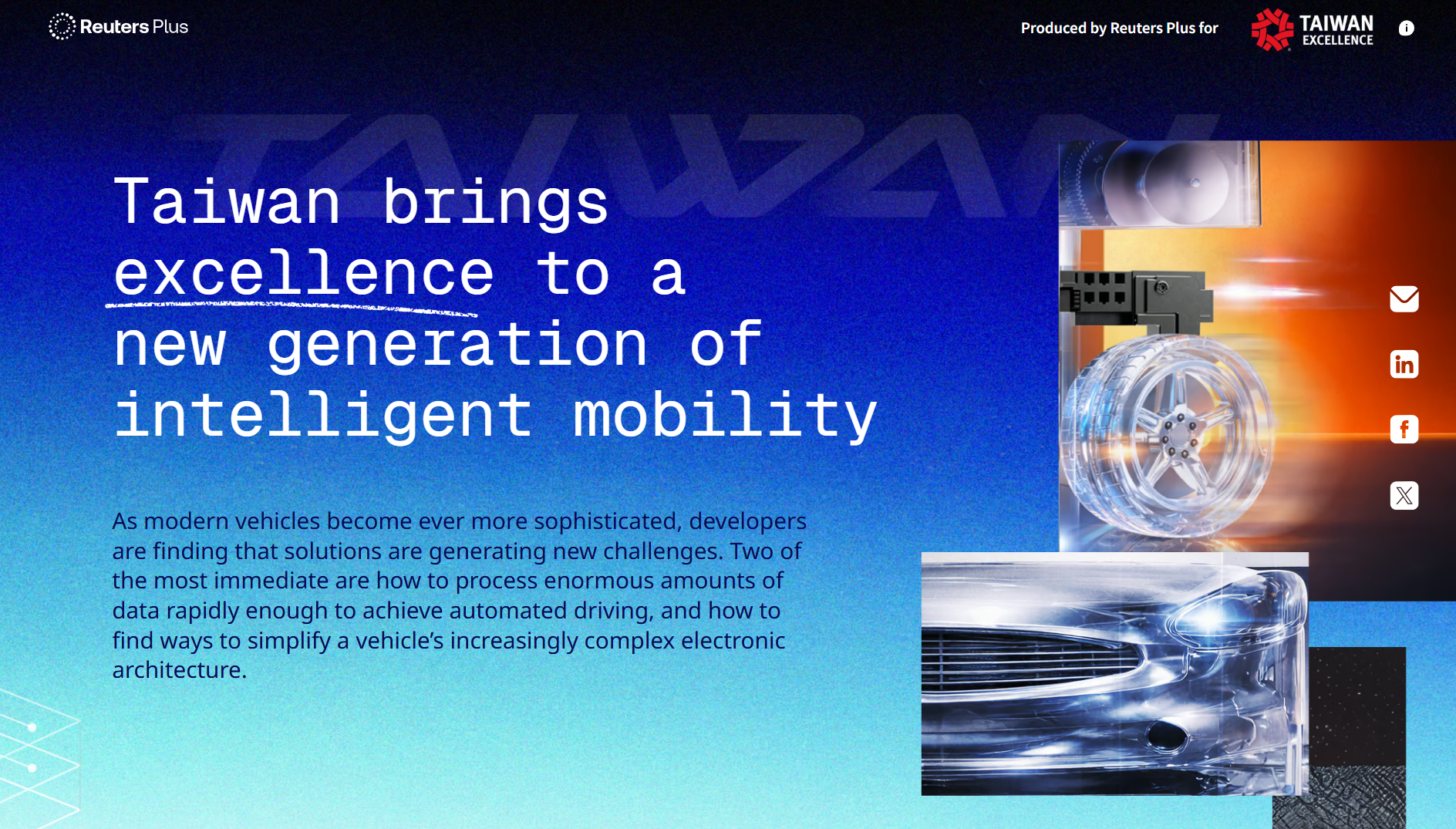
Reuters Plus has produced a feature exploring how Taiwan's automotive technology ecosystem is contributing to the next generation of intelligent mobility. Titled "Taiwan Brings Excellence to a New Generation of Intelligent Mobility," the feature highlights Taiwan's capabilities in high-performance computing (HPC), zonal controllers, automotive semiconductors, advanced sensing and system integration. It examines how collaboration among Taiwanese technology companies is helping address the growing complexity of modern vehicles and the evolving needs of global automakers.
1. Fewer Computers, More Capability: HPC and Zonal Controllers
As vehicles become increasingly intelligent and software-defined, automakers face two major challenges: processing enormous amounts of data rapidly enough to support automated driving and simplifying increasingly complex vehicle electronic architectures.
Taiwan's Delta Electronics is addressing these challenges through high-performance computing (HPC) systems for advanced driver assistance systems (ADAS) and autonomous driving, alongside zonal controllers for autonomous and intelligent driving vehicles (AIDVs).
HPC consolidates multiple computing workloads, including driver assistance, occupant monitoring and digital cockpits, into a centralized high-performance platform. Zonal controllers help reduce wiring harness weight, volume and cost while improving scalability across vehicle platforms.
Jay Huang, Director of Delta's Advanced Vehicle Architecture Department, emphasizes that collaboration with Taiwanese technology partners is critical to accelerating the development of next-generation automotive systems.
2. A Solid Tech Foundation: Taiwan's Automotive Technology Ecosystem
Taiwan's automotive capabilities extend beyond semiconductor manufacturing. Its industrial ecosystem connects IC design, wafer fabrication, testing, memory, connectivity, displays, sensing, power electronics, computing and system integration.
According to Brian Lee, Executive Director of TAITRA's Strategic Marketing Department, Taiwanese companies are increasingly applying their established ICT and electronics manufacturing expertise to automotive applications.
This cross-disciplinary collaboration brings semiconductor companies, sensor developers, electronics manufacturers and system integrators together to co-design, prototype and validate technologies. It enables suppliers to respond more quickly to complex customer requirements and deliver integrated solutions rather than individual components.
3. A New Kind of Responsibility: From Components to System Integration
Taiwanese suppliers are increasingly expanding their roles beyond individual component manufacturing toward subsystem design and system-level responsibility.
Stephen Su, Senior Vice President of Taiwan's Industrial Technology Research Institute (ITRI), highlights this evolution:
"The biggest change is not simply better manufacturing. It is the ability to take system-level responsibility."
This transformation requires expertise in system engineering, hardware-software integration, sensing, control, verification and validation, as well as safety and reliability.
Examples across Taiwan's automotive industry include CUB Elecparts' millimeter-wave radar technologies, Whetron Electronics' integration of camera, radar and ultrasonic sensing, and Pegatron's development of AI-powered smart cockpits and in-vehicle controllers.
4. Strength in Numbers: The Advantage of Taiwan's Industrial Eco-Chain
Taiwan's industrial ecosystem, or "eco-chain," brings together specialized companies with complementary engineering capabilities. This network supports faster co-design, prototyping, testing and modification of integrated automotive solutions.
For intelligent mobility, vehicle functions increasingly depend on the interaction of sensors, chips, modules, power electronics and control software. Having these capabilities within a connected industrial ecosystem helps companies coordinate development and respond flexibly to customer requirements.
Stephen Su emphasizes Taiwan's ability to move technologies from prototype to manufacturable products quickly, supported by a responsive and flexible supply chain.
For U.S. automakers and Tier 1 suppliers, Taiwan offers more than a source of semiconductor components. Its combination of technological expertise, manufacturing flexibility and growing system integration capabilities creates opportunities for long-term technology partnerships.
Read the Original Reuters Plus Feature
Discover how Taiwan's automotive technology ecosystem is contributing to the next generation of intelligent mobility, from HPC and zonal controllers to semiconductor innovation and cross-industry collaboration.
Taiwan Brings Excellence to New Generation of Intelligent Mobility — Reuters Plus
FAQ
Q1: What role does Taiwan play in the global intelligent mobility industry?
Taiwan provides an integrated automotive technology ecosystem covering semiconductors, sensing, connectivity, computing, power electronics, electronics manufacturing and system integration.
Q2: Which Taiwanese company develops automotive HPC and zonal controllers?
One example is Delta Electronics, which develops high-performance computing (HPC) systems for ADAS and autonomous driving, as well as zonal controllers for next-generation intelligent vehicle architectures.
Q3: Which Taiwanese companies develop automotive radar and sensing technologies?
CUB Elecparts develops millimeter-wave radar technologies, while Whetron Electronics integrates camera, radar and ultrasonic sensing for ADAS and smart-cabin applications.
Q4: Why are Taiwanese automotive suppliers relevant to U.S. OEMs and Tier 1 suppliers?
Taiwan combines semiconductor expertise, advanced sensing, electronics manufacturing and system integration capabilities, creating opportunities for cross-disciplinary engineering collaboration and long-term automotive technology partnerships.
Q5: What makes Taiwan's automotive supply chain flexible?
Taiwan's automotive supply chain benefits from close collaboration among semiconductor, sensing, electronics manufacturing and system integration companies. This connected ecosystem enables faster co-design, prototyping, testing and customization, allowing suppliers to respond flexibly to complex automotive requirements and accelerate the transition from prototypes to manufacturable products.
Q6: What is the Taiwan Excellence Award?
The Taiwan Excellence Awards were established in 1993 by Taiwan's Ministry of Economic Affairs (MOEA) to recognize and celebrate the exceptional achievements of Taiwan's most innovative products. Each year, eligible products go through a rigorous selection process that assesses their products based on four important factors: research and development, design, quality, and marketing with the key criterion of being Made in Taiwan.
The Taiwan Excellence mark has gained global recognition as a prestigious symbol of quality and design, showcasing Taiwan's impressive product innovation. For more information, visit https://www.taiwanexcellence.org/en.
Next article
2026-11-17